
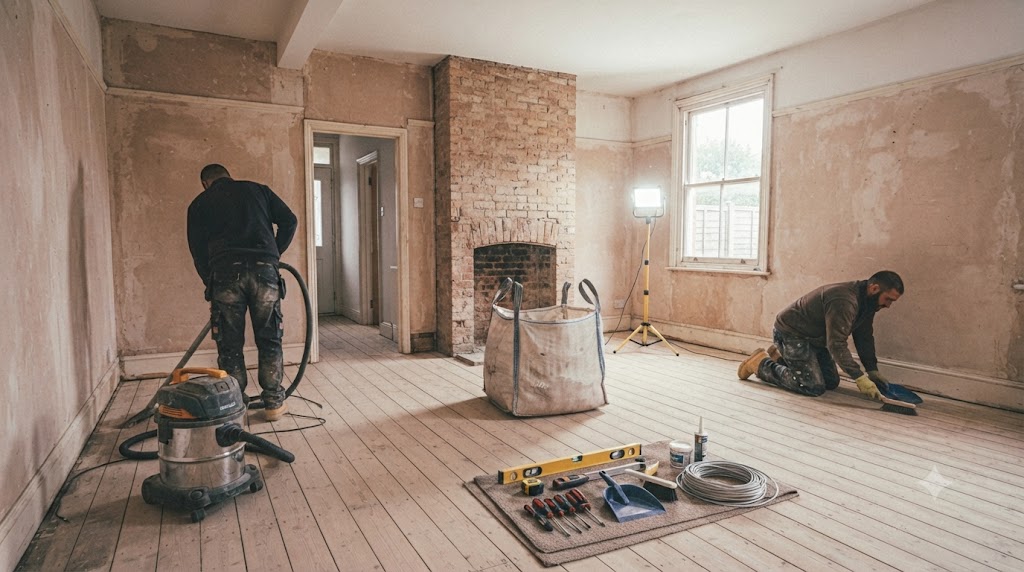
We get asked for a price per room or a price per square metre almost every week, and any contractor who gives you one over the phone without seeing the property is guessing. Two three-bedroom terraces on the same street can differ by days of labour depending on what's under the floors and how much has to be carried out by hand. What we can do is be completely open about what moves the number, so you can read a quote properly instead of just comparing totals.
The things that actually drive the price
1. Volume of material, not floor area
Strip out pricing is really waste pricing plus labour. A house with three layers of flooring, tiled walls in two bathrooms, lath-and-plaster ceilings and a loft full of contents produces several times the waste of a similar-sized house that's already half empty. Volume drives collection costs, and collection is one of the largest single line items in any strip out.
2. Scope — full strip or targeted rooms
A kitchen and bathroom strip is a very different job to taking a whole house back to a shell. Ceilings and floor screeds in particular add labour quickly, because they're slow to remove and heavy to carry.
3. Access
This is the factor people underestimate most. A detached house with a driveway where a vehicle can back up to the door is cheap to clear. A third-floor flat with a shared lift, a booked loading bay and a 40-metre carry to the vehicle is not — same material, far more hours. Terraced streets with no parking sit somewhere in between.
4. Occupied or empty
Working around a family or a trading business means isolation, protection, staged working and a full clean-down every day. That's the right way to do it, and it costs more time than an empty property where the crew can work continuously.
5. Hazardous or specialist material
Older properties can contain material that must be surveyed and handled by licensed specialists rather than a general strip out crew. If anything suspect is identified, work in that area stops and it's dealt with properly — that's a separate specialist cost, and no honest quote hides it inside a strip out figure.
6. Programme
A normal week's notice with a standard working day is the baseline. Same-day emergency response, overnight work, or weekend shifts to shorten a commercial void all add cost — sometimes worth every penny when rent or a fit-out date is on the line.
Does location within the North West change the price?
Less than people expect. We cover Liverpool, Manchester, Cheshire, Southport and Wirral as our core patch, so there's no travel premium loaded onto quotes within it. Where location genuinely bites is through access and property type rather than distance: Manchester city-centre commercial units carry landlord and out-of-hours constraints, Cheshire properties are often larger and older so they take longer, and city-centre apartments anywhere cost more to clear than a house with a drive.
How to compare two quotes fairly
- Is licensed waste removal and duty-of-care paperwork included, or extra?
- Are ceilings, floor screeds and adhesive removal in scope, or only the easy layers?
- Who isolates gas, water and electrics, and is that priced?
- Is protection of floors, stairs, lifts and communal areas included?
- What condition is the property handed back in — swept and empty, or just emptied?
- Is the price fixed, or a day rate that can run on?
- What happens if the scope grows once the floors come up?
A quote that's meaningfully cheaper than the others usually has one of those answers missing. Ask which one.
How we price
Free survey, written fixed price, waste and paperwork included, and a clear note of anything that could change the figure before it does. If photos are enough for us to give you a sensible indication, we'll do that first so you're not sitting through a visit for a job that was never going to fit your budget.
Want this priced for your property?
Free survey, written fixed price, waste and paperwork included — across Liverpool, Manchester, Cheshire, Southport and Wirral.