
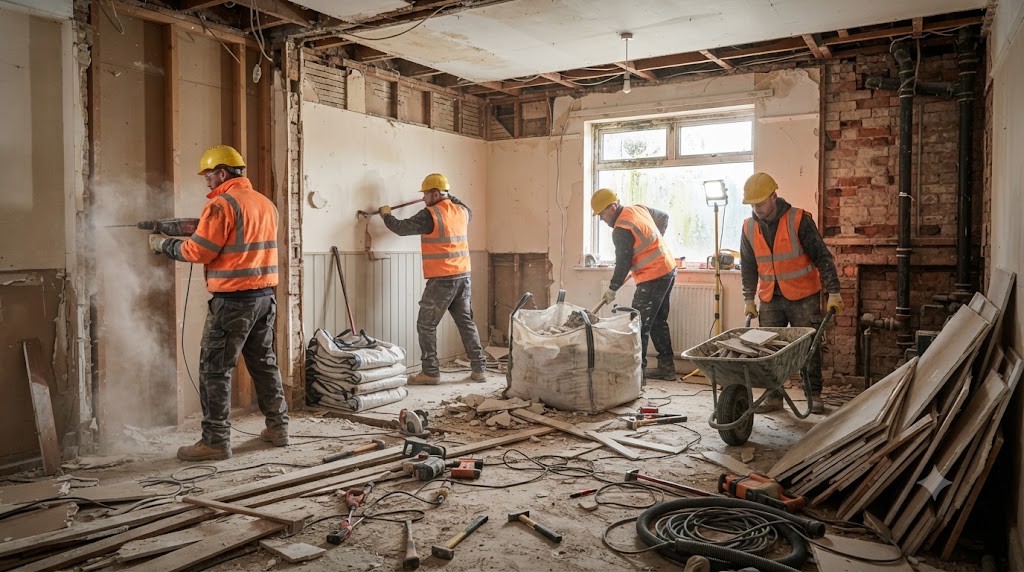
"Soft strip" is one of those trade phrases that sounds vague until you've watched one happen. In plain terms it's the removal of everything inside a building that isn't holding it up. Kitchens, bathrooms, ceilings, partitions, floor coverings, doors, fixtures, fittings, redundant services — out. Structure, load-bearing walls and the building envelope — untouched. What you're left with is a clean shell that a builder or fit-out team can start work in immediately.
What actually comes out
On a typical residential job the scope looks something like this, though every property throws up its own surprises once you open it up:
- Kitchen units, worktops, splashbacks, sinks and appliances
- Bathroom suites, tiling, boxing and shower enclosures
- Floor coverings — carpet, laminate, vinyl, tile, adhesive and screed where specified
- Ceilings, whether lath-and-plaster, plasterboard or suspended grid
- Non-structural stud and partition walls
- Internal doors, frames, skirtings, architraves and built-in furniture
- Redundant pipework, cabling, radiators, containment and dead services
On a commercial unit the list changes shape but not principle: shopfittings, counters and bars, commercial kitchen equipment, suspended ceilings, partitions, cabling and containment, signage and floor finishes.
What stays
Load-bearing walls, floors, roof structure, windows and external doors all stay. So does anything you tell us to keep — and this is the part worth being deliberate about. Original fireplaces, stained glass, cornicing, panelled doors and cast radiators are easy to lose in the middle of a busy strip if nobody wrote them down. We agree a keep list at survey stage, and anything on it gets protected or removed carefully and set aside.
Live services stay live until they're properly isolated. Gas, electrics and water are capped or isolated by the right person before anything comes off the wall — not mid-strip because something started dripping.
How the property gets protected
A strip out is a dusty, heavy job happening inside a building someone still owns. The difference between a good crew and a cheap one is almost entirely in the protection. Floors and stairs on the route in and out get boarded or sheeted. Doorways get sealed where we're generating dust. In flats and blocks that extends to lift cars and communal corridors, because a mark in a shared hallway is a mark someone else has to pay to fix.
In occupied properties — a family living around a kitchen refurbishment, or a shop trading beside a unit being stripped — the work area is isolated and left safe and clean at the end of every shift, not just at the end of the job.
Waste, and why paperwork matters
A strip out generates a lot of mixed waste, and it's your legal duty of care as the property owner to know where it went. Working with a licensed waste carrier means you get transfer documentation for the material that leaves your property. If a quote is unusually cheap and nobody mentions waste paperwork, that's the question to ask.
What handover should look like
A finished soft strip should be an empty, swept property with services capped, waste gone, and nothing left in the garden or on the frontage. Not a building site with a pile of rubble in the back room and a skip you've inherited. That's the standard we work to, and it's a fair standard to hold any contractor to.
If you're not sure whether your project is a soft strip, a clearance or something heavier, send a couple of photos and we'll tell you straight — including when the honest answer is that it's not a job for us.
Want this priced for your property?
Free survey, written fixed price, waste and paperwork included — across Liverpool, Manchester, Cheshire, Southport and Wirral.